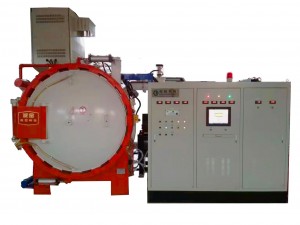
VIM-HC Vacuum Induction Electromagnetic Levitation Melting


Applications:
• Golf club heads made of titanium;
• Titanium-aluminum automotive valves, hot-end turbocharger wheels;
• Structural and engine components for the aerospace industry (titanium castings);
• Medical implants;
• Production of active metal powders;
• Pump castings and valves made of zirconium, used in the chemical industry and marine drilling, etc.
The principle of levitation melting:
The VIM-HC vacuum levitation melting furnace places the metal to be melted in a high-frequency or medium-frequency alternating electric field formed by an induction coil under vacuum conditions. A water-cooled metal crucible acts as a "concentrator" of the magnetic field, focusing the energy of the magnetic field within the crucible's volume. This creates strong eddy currents near the surface of the charge, releasing Joule heat to melt the charge and simultaneously generating a Lorentz force field that levitates (or semi-levitates) and stirs the melt.
Due to the magnetic levitation, the melt is decoupled from the inner wall of the crucible. This changes the heat dissipation behavior between the melt and the crucible wall from conduction to radiation, significantly reducing the heat loss rate. This allows the melt to reach very high temperatures (1500℃–2500℃), making it suitable for melting high-melting-point metals or their alloys.
Technical Advantages:
Remelting and alloying;
Degassing and refining;
Cruiseless melting (suspension melting);
Recycling;
Thermal reduction purification, zone melting purification, and distillation purification of metallic elements;
2. Casting
Directional crystallization;
Single crystal growth;
Precision casting;
3. Special Controlled Forming
Vacuum continuous casting (bars, plates, tubes);
Vacuum strip casting (strip casting);
Vacuum powder production;
Product Classification:
* Suspension of the furnace charge during smelting effectively prevents contamination from contact between the charge and the crucible wall, making it suitable for obtaining high-purity or highly reactive metallic and non-metallic materials.
* Electromagnetic stirring of the melt provides excellent thermal and chemical homogeneity.
* Control of melt temperature and suspension via medium- or high-frequency current from the induction coil achieves excellent controllability.
* High smelting temperature, exceeding 2500℃, capable of melting metals such as Cr, Zr, V, Hf, Nb, Mo, and Ta.
* Induction heating is a non-contact heating method, avoiding the impact and volatilization caused by plasma beam or electron beam heating methods on the crucible and molten metal.
* Comprehensive functionality, including smelting, bottom casting, tilting casting, and charging functions, and can be equipped with continuous charging, continuous billet pulling devices, and centrifugal casting devices (optional).
Technical specification
|
Model |
VIM-HC0.1 |
VIM-HC0.5 |
VIM-HC2 |
VIM-HC5 |
VIM-HC10 |
VIM-HC15 |
VIM-HC20 |
VIM-HC30 |
VIM-HC50 |
|
Capacity KG |
0.1 |
0.5 |
2 |
5 |
10 |
15 |
20 |
30 |
50 |
|
MF POWER KW |
30 |
45 |
160 |
250 |
350 |
400 |
500 |
650 |
800 |
|
MF KHz |
12 |
10 |
8 |
8 |
8 |
8 |
8 |
8 |
8 |
|
MF Voltage V |
250 |
250 |
250 |
250 |
400 |
400 |
500 |
500 |
500 |
|
Ultimate vacuum Pa |
6.6x10⁻¹ |
6.6x10⁻³ |
|||||||
|
Work vacuum Pa |
4 |
6.6x10⁻² |
|||||||
|
Pressure raise rate Pa |
≤3Pa/h |
||||||||
|
Cooling water pressure MPa |
Furnace body and power supply: 0.15-0.2 MPa; Water-cooled copper crucible: 0.2-0.3 MPa |
||||||||
|
Cooling water required M3/H |
1.4-3 |
25-30 |
35 |
40 |
45 |
65 |
|||
|
Gross weight Ton |
0.6-1 |
3.5-4.5 |
5 |
5 |
5.5 |
6.0 |
|||